
Separate Coweta County Assessment and Tax Records
Coweta County property tax records come from two separate offices. The Board of Assessors sets the certified value, assigns the parcel classification, and applies any exemptions. The Tax Commissioner then issues the bill, records payment status, and tracks delinquency. Keep the two straight. A notice of assessment is not a bill. Neither document tells a buyer what must be paid for the land itself.
| Field | What It Shows | Where |
|---|---|---|
| Fair market value | Assessor's estimate of full value | Assessment record and notice |
| Assessed value | Georgia's taxable base before exemptions | Board of Assessors |
| Other value | Preferential-assessment amount when applicable | 2026 assessment notice |
| Exemptions | Homestead or other approved relief | Assessment record |
| Bill and balance | Charge, payment, and delinquency status | Tax Commissioner |
| FiFa | Execution arising after unpaid tax becomes delinquent | Tax office and General Execution Docket |
Georgia law generally taxes property at 40 percent of fair market value. That starting point is only the beginning. Exemptions and preferential programs shrink the taxable figure. The millage rate then turns the taxable base into the charge you owe. A recent recorded sale is evidence worth reviewing. It never replaces the assessor's annual judgment of value.
Follow Coweta's January-to-December Tax Calendar
Coweta County taxes on a calendar-year clock, and everything starts with January 1. That is the date the assessor uses to review each parcel's value and ownership. Annual notice letters go out after that review. Each notice opens its own appeal window tied to the date printed on it. Billing follows in the fall. The Tax Commissioner mails tax bills in October to whoever held title as the owner of record on January 1. Payment is generally due by December 1. So a buyer who closes in, say, June can be surprised. The seller's name is still on the bill. That is how the Coweta County system works, not an error in the deed records. Keep the whole paper trail together: assessment notice, parcel card, tax bill, and any deed recorded afterward. And never assume a bill date proves when ownership changed.
Note: The January 1 owner of record on a tax bill can differ from the grantee named on a deed recorded later that year.
Read Coweta's 2026 Assessment Notice Format
Coweta's official 2026 notice was mailed June 19, 2026. It shows prior and current values at 100 percent fair market value, an Other Value field for preferential assessment, estimated tax savings, and an August 3 appeal deadline. The form also states plainly that it is not a tax bill, and it flags a format change tied to SB 566 under state law.
Read every field rather than one bold number. Land, improvements, exemptions, Other Value, and the estimated-tax display each do different work. The actual October bill comes later from the Tax Commissioner.
Verify Coweta Tax-Bill Rules at the Source
The Tax Commissioner's tax-bill information page lays out mailing dates, due dates, interest, penalties, and how a FiFa is treated.
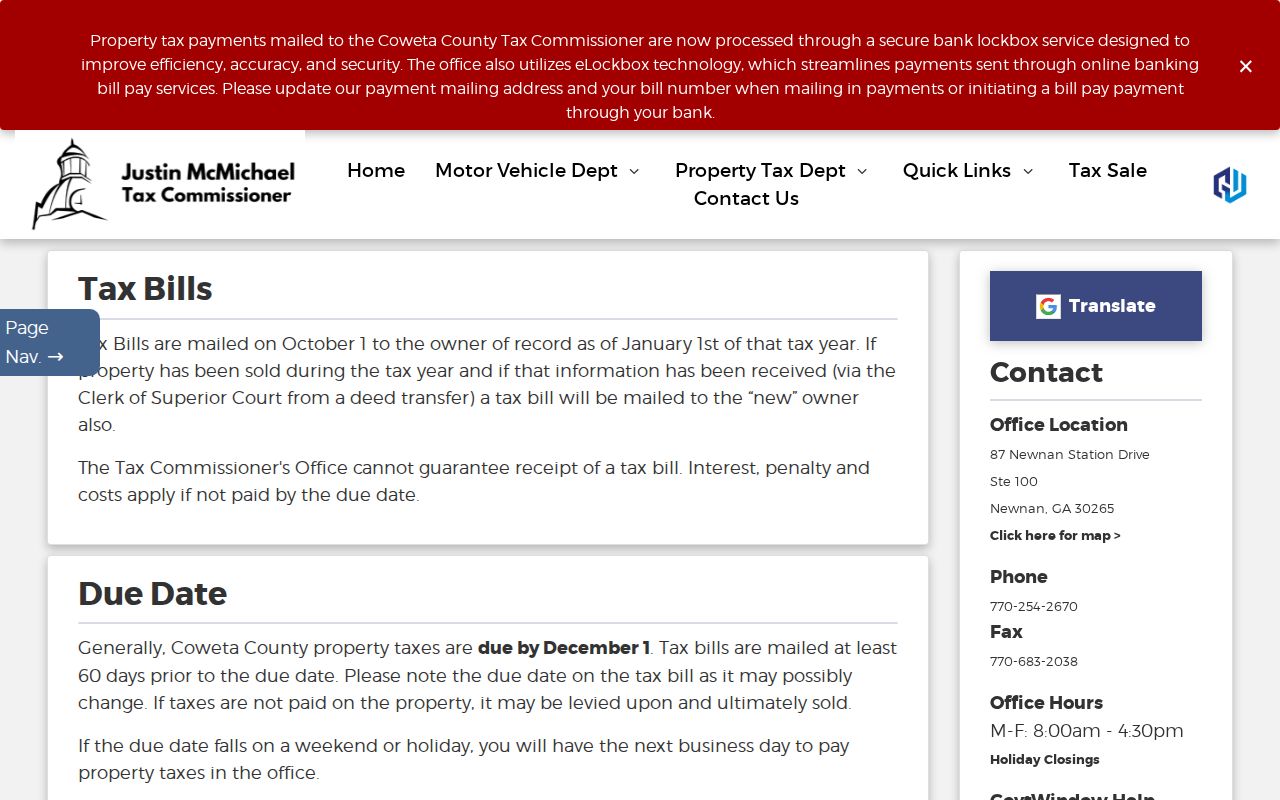
That page supplies the context you need before reading any balance or delinquent entry in the payment portal.
Look Up a Coweta County Tax Bill
Start with the exact parcel number from QPublic. Then open the Search and Pay Taxes portal and run the lookup there. If the portal cannot complete a search, use the Tax Commissioner's contact route instead. The office can confirm the bill directly.
- Find the parcel in QPublic and copy its number exactly.
- Search the Tax Commissioner portal and select the matching tax year.
- Read the bill, balance, payment status, and owner name as of the tax date.
- Compare exemptions and value fields on the assessor record.
- If delinquent, check FiFa and official tax-sale information rather than assuming a sale is scheduled.
- Assessed value
- The statutory percentage of fair market value used before exemptions.
- Millage
- The rate applied to the taxable assessment.
- Homestead exemption
- Approved relief tied to a qualifying primary residence.
- FiFa
- A tax execution entered when an obligation remains delinquent.
Match Coweta Exemptions to the Assessment Record
The Board of Assessors exemption page covers homestead, senior, veteran, conservation-use, and other preferential programs. Each program carries its own eligibility and application rules. An exemption lowers taxable value. It does not touch the assessor's estimate of full market value.
Check the parcel record to see which exemption was actually applied. Then rely on the official program page for requirements. Never infer eligibility from age, land use, or a prior owner's status.
From a Coweta Delinquent Bill to FiFa and Tax Sale
When tax stays unpaid past the due date, the Tax Commissioner adds interest and penalties and issues a FiFa, a lien entered in the General Execution Docket. The office also acts as ex-officio sheriff in the tax-sale process, which involves notice and procedure that reach well beyond a delinquent balance. A scheduled sale can sit months ahead of the delinquency itself.
The tax-sale list can name the next scheduled sale. Treat any listed date as a plan, not a promise. Always confirm against the current tax-sale page and the parcel's own bill before relying on either.
Appeal a Coweta County Property Assessment
A Coweta appeal must be filed within 45 days of the notice date. The county appeals page walks through the PT-311-A elements and the available paths. Those paths include the Board of Equalization, arbitration, a hearing officer where allowed, and later Superior Court review. Strong evidence might include the parcel card, photographs, comparable sales, a survey, or an appraisal. Aim the evidence at the disputed issue.
File with the Board of Assessors by the deadline printed on the notice. Keep proof of submission. A phone call about a value is not a substitute for a timely filing. And remember that the assessment record is separate from the bill. A valuation dispute belongs with the assessor, not the payment portal.
Appeal window. A Coweta assessment appeal must be filed within 45 days of the notice. The 2026 notice listed August 3, 2026 as its deadline.
Build a Coweta Assessment Record Before Appealing
Assemble the file before you file anything. Save the notice, the complete QPublic card, and the deed or plat identifying the tract. Check land and improvement values separately. Note any exemptions and Other Value. Also confirm the assessor used the parcel configuration shown on the latest recorded plat. Photos and repair facts matter when they speak to condition on the valuation date.
Choose comparable sales carefully. They should involve similar property and the relevant time period. Keep copies of the filed appeal and every attachment. The review path decides who hears the dispute. But this factual record is what defines what is contested.
Send Coweta Property Tax Questions to the Right Office
Coweta County splits property tax work between two offices. The Board of Assessors handles value, classification, parcel details, exemptions, and appeals. Bills, payments, penalties, FiFas, and tax sales are the Tax Commissioner's domain. Recorded deeds and General Execution Docket entries sit with the Superior Court Clerk. Knowing this split saves real time.
It keeps you from asking the payment office to change an assessment. It also keeps you from asking the assessor to post a payment. When a portal fails, contact its custodian. Give them the parcel number and tax year. For a county record not indexed online, Coweta's Open Records Request offers a written fallback.