
Reconstruct Coweta's Ownership Timeline
A former-owner search in Coweta County starts with a transfer timeline. Build it one deed at a time. Every row should stand for one verified deed. It must cover the same land, never just a matching surname. For each transfer, log the dates, both parties, deed type, and the book/page or instrument reference. That reference anchors the entry in the deed records.
| Transfer date | Grantor to grantee | Deed type | Book/page |
|---|---|---|---|
| Newest verified filing | Seller to current grantee | As indexed | Record exact reference |
| Prior linked filing | Earlier seller to that grantor | As indexed | Match the same tract |
| Earlier book entry | Historic grantor to grantee | Read from image | Book and page |
Street addresses fade quickly in older Coweta County deed records. Keep the chain tied to land district, land lot, town lot, subdivision, acreage, and adjoining owners instead. A later parcel split may simply mean the prior deed covered a larger parent tract.
Coweta Deed Names Run Backward
The Coweta deed name search asks for several filters. Enter a name, party type, and date range. Add book type, instrument type, and a reverse-party filter. Enter the last name first. Leave off any suffix. Spelling variants help, and company names should drop their punctuation. With these controls you can isolate a prior owner's acquisition. Later mortgages, releases, and unrelated filings fall away. The newest deed names the grantor. Search that person as a grantee. Use an earlier date range, then compare legal descriptions carefully. Book/page, district, and land lot anchor the record. Subdivision, block, lot, unit, and acreage give the strongest continuity tests. The street address matters far less than these parcel details.
Coweta's 1999 Online Threshold
The GSCCCA statewide index reports deed index data from at least January 1, 1999. Older records are added over time. That threshold is not the start of Coweta County land ownership. Nor does it guarantee identical coverage for every instrument type in the deed records. Note the date range you actually search.
Older-chain route. When the modern search stops, move to Coweta's Index-to-Index images, deed books, the clerk counter, and established archival finding aids.
The clerk portal posts separate good-through dates for deeds, liens, and plats. Treat them as three different clocks. A later plat or lien can carry a different freshness date than the deed anchoring the owner chain.
Go Back Through Coweta Deeds
Trace Coweta County former owners one transfer at a time. Skipping generations invites false links whenever the same surname appears on several parcels in the property records.
- Find the current owner's acquiring deed and match its legal description.
- Read the grantor's exact indexed name and record the filing reference.
- Search that grantor as an earlier grantee and confirm the same land.
- Repeat until the web index ends, then continue with historic book references.
- Grantor
- The party conveying the interest.
- Grantee
- The party receiving the interest.
- Chain of title
- The linked sequence of conveyances for the same land.
- Reverse index
- An index organized by the other party role to help step backward.
- Quitclaim and warranty
- Different deed forms whose legal effect must be read from the instrument.
For a certified copy or a fuller explanation of instrument types, use the Coweta deed records page. It covers the deed records in more depth.
Index-to-Index Opens Old Coweta Books
The historic Index-to-Index system preserves the older workflow for Coweta County deed books. Pick a book and section. Inspect the TIF index image. Write down the book/page, and pull the underlying record with that reference. Handwriting, old type, surname variants, and damaged entries can defeat any modern-style property search.
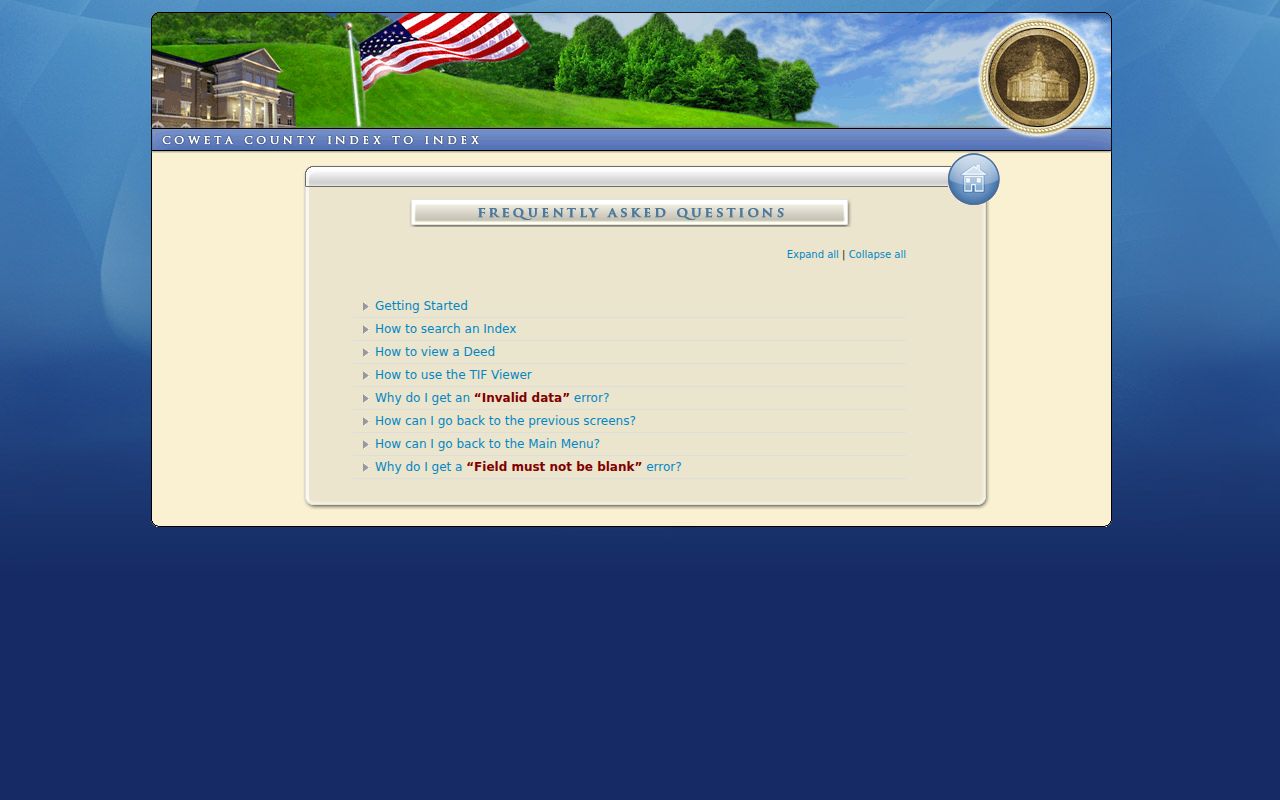
The Index-to-Index page itself shows why former-owner research becomes a book-and-image task rather than a simple address lookup. The alphabetized book lists move the search along one volume at a time. The Coweta County Genealogical Society inventory identifies General Index Book 1 for 1827 to 1871, Book 2 for 1871 to 1886, Book 3 for 1886 to 1902, Book 4 for 1902 to 1911, and Book 5 for 1912 to 1917. It also lists mortgage and deed-index holdings. Treat the inventory as a map to the evidence. Only the recorded deed itself proves a former owner.
Old Coweta Descriptions Change Shape
Coweta County was formed in 1825, long before street addresses and digital parcels. Early deeds lean on land district, land lot, town lot, metes and bounds, roads, streams, and neighboring owners instead. A modern parcel number is not a permanent title identifier. Preserve the old wording exactly. Compare it against later plats in the property records. Municipal history supplies search terms too. Senoia records preserve the predecessor names Location and Willow Dell. Newnan's older grid and town lots can point away from a current street label entirely. These names bridge identity and geography. Only the recorded deed confirms a former owner.
Plats Explain Coweta Parcel Splits
A subdivision plat or lot-line adjustment often explains why an earlier owner held a larger tract. The clerk's land-description search asks for subdivision and land district, and it can add land lot, block, lot, and unit. Pull the final recorded plat. A proposed city plan is not the same thing. Senoia's Baker Homes/Gin Property review shows the difference clearly. It names Land Lot 260, First District, lots 13 and 15A, two line adjustments, and two addresses. Those planning facts are leads only. The county plat and the deed chain decide what was finally created or conveyed.
Probate Can Bridge Coweta Owners
Sometimes no clean deed connects two owner names directly. A death usually sits between them. Coweta Probate Court filings can name the decedent, a representative, the heirs, and whoever gained authority to transfer real property. Once you have those names, chase the executor's deed, distribution deed, affidavit, or recorded order in the clerk's index. That instrument is the link your chain needs.
One caution applies. A probate petition lists assets, but it does not prove which asset was your parcel. Match the legal description before you trust the match. Older family names open other doors too. The Coweta County Genealogical Society, the Georgia Archives, and local library collections can confirm identities and relationships before you return to the deed books.
Marriage records solve a different puzzle: the former owner who appears under two surnames. Search both names, and try the reverse party field. Then demand the same book reference or land description from each hit. Obituaries and family histories play the same identity-bridge role. All of them build a hypothesis. Only the deed proves the transfer.
Watch for split estates as well. An estate deed may have conveyed just part of a tract, so compare acreage and reservations against the next deed in line. A single modern assessor parcel can be one slice of property that several heirs once shared. That is why the backward chain tracks the land as tightly as it tracks the names.
Coweta Former Owners Reach 1827
Coweta County's earliest clearly identified index material reaches back to 1827. That depth is real. It gives former-owner research here a potential trail of nearly two centuries. Yet it guarantees nothing about completeness, since not every book, year, deed type, or image is available online. State plainly where your chain stops. Record which index, spelling variant, date range, and land description you tested before drawing conclusions.
Lawful use. Research former Coweta County owners for house history, estates, and property diligence. Never use land records to track or harass a living person.
A gap in the record is not proof that nothing happened. It usually means the transfer sits in an unindexed volume. Ask the Superior Court Clerk at the counter. Consult the historic books. File a focused open-records request when you know a record exists but cannot find it indexed.
The clerk's counter at 72 Greenville Street in Newnan remains the essential access point for books and images. It also offers full GSCCAA searching through the state system. For local context, the Coweta County Genealogical Society library at 8 Carmicha…