
Read Coweta County Deed Records by Instrument Type
The Superior Court Clerk keeps Coweta County deed records. The same office also holds mortgages, liens, releases, plats, and other real-estate instruments. An index entry only tells you what came in and was recorded. So work in order: pin down the document type first. Then pull the parties, the recording date, and the book and page or instrument number. The land description comes from the entry too.
| Deed type | What it does | Common use |
|---|---|---|
| Warranty deed | Conveys the stated interest with covenants in the instrument | Ordinary sale transfer |
| Quitclaim deed | Conveys whatever interest the grantor holds | Interest cleanup or family transfer |
| Executor or administrator deed | Conveys through an estate representative | Probate transfer |
| Tax deed | Documents a tax-sale transfer | Delinquent-tax property |
| Security deed | Records a security interest, not an outright conveyance | Financing research |
A deed moves an interest in land. A security deed, lien, or release touches the same land but works differently, and none of them is that kind of conveyance. Open the image. Read the legal description before you decide what an index row really means.
Use Coweta's Three Deed Search Modes
The Coweta Real Estate Search splits its queries three ways: party name, land description, and book or page. The name side takes last or company name, first name, party type, a date span, book information, instrument information, and reverse party. The land side accepts subdivision, district, land lot, block, lot, and unit.
| Route | Known fact | Goal |
|---|---|---|
| Name | Grantor or grantee | Indexed instruments for a party |
| Land | Subdivision, land lot, block, lot | Records tied to the tract |
| Book/page | Recording citation | Direct image retrieval |
Start with fewer filters. Widen the date range only if the first pass comes up empty. Older land often has no useful modern street address, so lean on land lot and district clues instead.
Check Coweta Deed and Plat Freshness Separately
The official portal landing page posts separate good-through dates for each record class, with deeds indexed through August 31, 2026, liens through August 29, and plats through August 28. Always confirm each class before you rely on it.
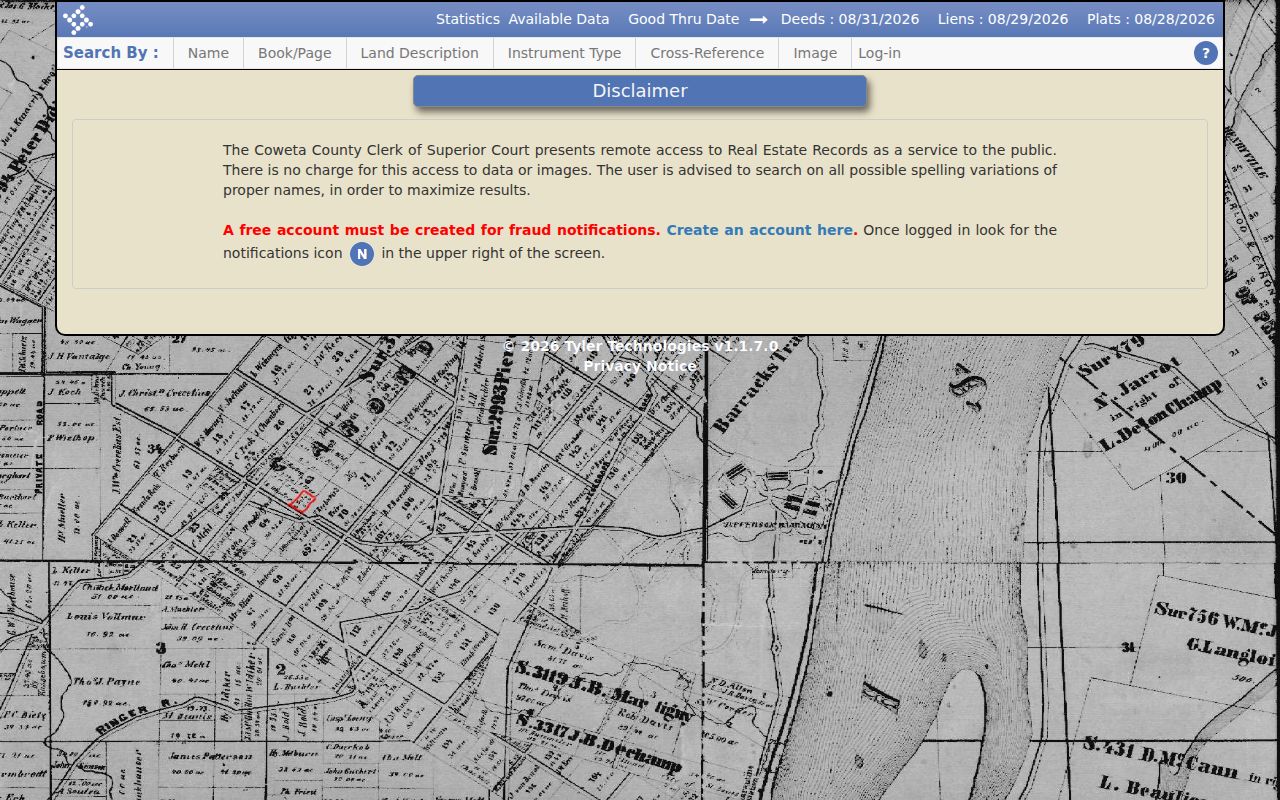
That screen makes plain why one good-through date should never be assumed to cover every instrument type. The party search lays out the controls a grantor or grantee trace depends on.
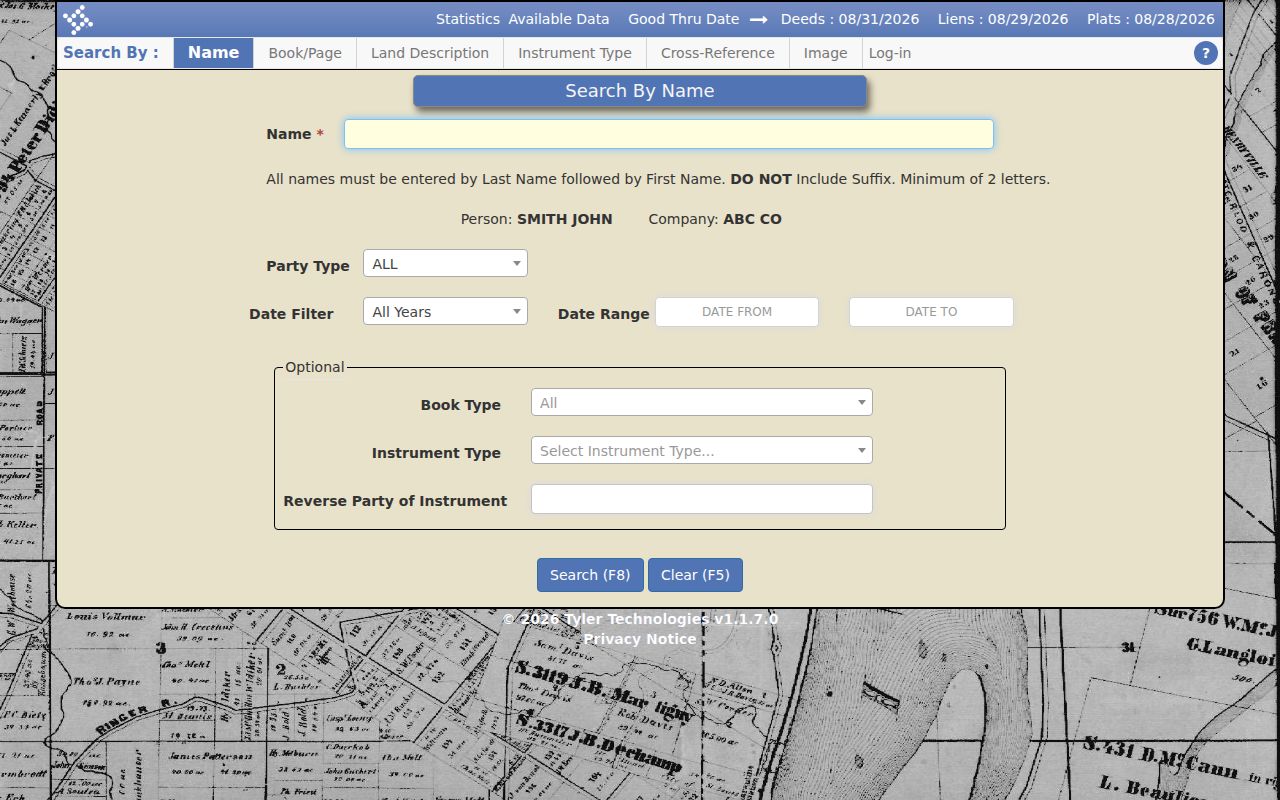
Its party-type and reverse-party fields support a chain search beyond a simple surname list.
Trace Coweta County Deeds Through Grantors and Grantees
Every chain starts with the current acquisition deed. The buyer appears as grantee and the seller as grantor. Then match the legal description at each step, because a person may have held other land in Coweta County, and a chain built on name alone will drag that land in by mistake.
- Find the most recent deed into the current grantee.
- Copy the grantor, legal description, and recording reference.
- Search that grantor as an earlier grantee.
- Confirm the same tract and repeat.
- Move to historic index books when the modern index ends.
- Grantor
- The party transferring the stated interest.
- Grantee
- The party receiving it.
- Chain of title
- The linked sequence of conveyances for the same land.
- Book/page
- A volume-and-page citation.
- Instrument number
- A modern filing identifier.
The former-owner guide builds out that backward timeline in detail, while this page stays on deed records and how to retrieve them.
Coweta's Deed Index Has an 1827 Trail
The statewide online deed index from GSCCCA reaches back to at least January 1, 1999. Older records get added unevenly. Coweta's own history goes much deeper. General Index Book 1 spans 1827 through 1871, and the clerk's Index-to-Index arranges older material by book, section, and TIF image. Old legal descriptions may point to town lots, districts, land lots, or named subdivisions. They may not name any street. The Coweta County Genealogical Society and Georgia Archives finding aids open offline routes too. Senoia deeds can even carry the predecessor place names Location or Willow Dell.
Note: The 1999 statewide web benchmark is not the start of Coweta County deed records.
Recorded Coweta Plats Explain Lot Changes
A final recorded plat ties a short lot-and-block deed description to its subdivision. It can expose line adjustments, road dedications, or easements. Senoia's Baker Homes/Gin Property review shows how this works. It names Land Lot 260, First District, lots 13 and 15A, plus two line adjustments. That city review is only context. The county's final plat and deed remain the record evidence. A preliminary plat or planning approval, by contrast, conveys nothing. Confirm the final book and page. Then compare the deed legal description before treating any proposed boundary or lot count as recorded.
FANS Monitors New Coweta Filing Activity
The free GSCCCA Filing Activity Notification System can alert a subscriber when clerk-transmitted index activity matches a registered name. It looks forward only. It will not reconstruct a historic title chain.
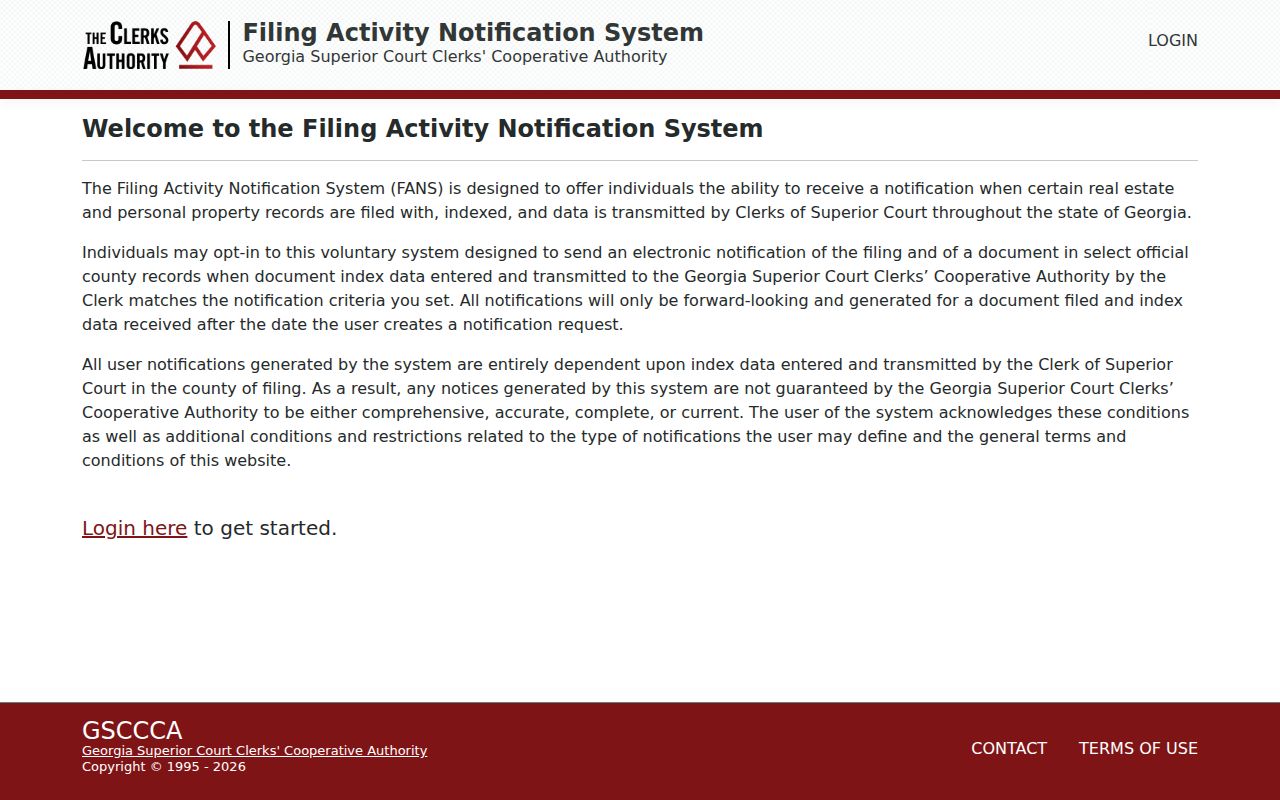
Pair the service with a periodic check of the local deed index and the county's assessment record for the parcel.
Get a Coweta County Deed Image or Certified Copy
The local portal gives free index access and images. The statewide GSCCCA Real Estate Index offers a limited free account, subscription-based full internet searching, and no-charge full searching at any county Superior Court Clerk office. For a stubborn citation, an older index, or a certified copy, the Coweta clerk counter at 72 Greenville Street in Newnan is the direct fallback. Save the complete book and page or instrument number before you go. Say whether an image will do or you need certification. When material is not indexed online, hand staff the parties, an approximate date, the document type, and the land description so they can scope the search.
Recorded, not guaranteed. Coweta County deed records show indexed filings. They are not a title opinion, and unrecorded interests or indexing errors may require professional title work.
Use the Clerk Counter When a Coweta Deed Search Stalls
Remote access is one channel among several. At the Superior Court Clerk's counter, a researcher can run the full statewide real-estate search without the remote subscription that full GSCCCA searching otherwise requires. Counter staff can also sort out the right index series when a citation points to an older book or a scanned image proves hard to read. Bring names, date ranges, and every land clue you already hold. A phone or mail request should state the document type, the parties, the approximate recording date, the book and page or instrument number if known, and whether certification is needed. Historical digging can continue through the Coweta County Genealogical Society's deed, general, and mortgage-index holdings or through the Georgia Archives catalog. Coweta County deed records reward that kind of persistence.
Match Each Coweta Deed to the Same Land
A name by itself proves little. To build a real chain in Coweta County deed records, compare district, land lot, subdivision, block, lot, unit, acreage, and the adjoining land calls. A split can leave a newer deed covering only part of an older tract. A merger works the other way. Plats fill the gap whenever a deed shrinks its description to a simple lot-and-block reference.
Book and page references matter more than street addresses in older Coweta County deed records. Streets change names over time. But a recorded description stays anchored to its original plat or survey. When the clerk index returns several instruments for the same family, land-description continuity is what keeps the correct chain intact.
Give each record its own job. The deed documents the conveyance, the plat maps the survey geometry, and the assessment roll handles annual tax administration. A title examination settles any unresolved interests.